


Waterfront MAR#KET
Project TitleMultipurpose Amphibious Rover a Key Enabling Technology for Waterfront Market
- SeTel Srl – Lead Partner
- University of Rome الثلاثar / Roma Tre University (Università degli Studi di Roma Tre)
The MAR#KET project represents the evolution of the ECOMAR project, aiming to bring the MAR (Multipurpose Amphibious Rover) platform from TRL 7 to TRL 8 through re-engineering, validation in a real operational environment, and preparation for industrialization. The project aims to develop an autonomous robotic platform for environmental water monitoring, integrating advanced sensors and intelligent analysis systems capable of early detection of pollution phenomena, contributing to biodiversity conservation, ecological transition, and the strengthening of the national environmental technology supply chain.
The project involves the re-engineering of the MAR platform to improve its mechanical, electronic, and software performance, transforming it into an advanced solution for environmental monitoring. The platform will be equipped with next-generation sensors for detecting major physical-chemical water parameters and with intelligent data analysis and early warning algorithms capable of promptly identifying any anomalies. Activities will include the collection and analysis of environmental data, validation of the solution in laboratory and real operational scenarios, as well as the creation of a multi-purpose mobile laboratory to support monitoring campaigns. The project will conclude with the optimization of the platform in view of future industrialization and commercialization, enhancing technological transfer and scientific collaboration between SeTeL and Roma Tre University.
- Lazio ERDF Regional Program 2021-2027 (Programma Regionale FESR Lazio 2021-2027)
- Specific Objective 1.6 STEP – Critical Technologies and Competence Strengthening Actions
- Specific Objective 2.9 STEP – Clean and Resource-Efficient Technologies


BI@VALVIA 4.0
Project TitleSMARt Farming & Alien Sentinel – innovative system for monitoring, inspection, maintenance, and sampling activities in aquaculture
The primary objective of the project is the creation of an amphibious system specifically applied to aquaculture, with a particular focus on mollusk farming. The technology we will develop will be equipped to perform the following activities:
- Water monitoring and sampling within breeding facilities;
- Inspection through the introduction of AI for defense against alien species;
- Facility maintenance.
The project idea combines the enabling technology of the MAR (Multipurpose Amphibious Rover) with a mechanical arm equipped for water monitoring, inspection, maintenance, and sampling activities in aquaculture, with a specific focus on mollusk farming. The Rover, integrated with the mechanical arm featuring sensors, actuators, and AI, makes it possible to certify water quality by measuring chemical variables in real-time and taking samples for subsequent biological analysis. The results are communicated to the ground control station (Ground Station), which will be able to provide indications of any risks (early warning) related to the presence of alterations. The rover features autonomous navigation, low energy consumption, and low personnel requirements.
The project is financed with resources from the National Recovery and Resilience Plan (NRRP / PNRR) Mission 4, "Education and Research" – Component 2 "From Research to Business" – Investment Line 1.4, "Enhancement of research structures and creation of 'National R&D Champions' on certain Key Enabling Technologies", funded by the European Union – NextGenerationEU.


HYDROMAR
Project TitleHydro Multipurpose Amphibious Rover
The primary objective of the project is the creation of an amphibious system, named HydroMAR, with high fast-deploying capacity for early warning and risk analysis operations, drinking water monitoring, and inspections of water infrastructure and artificial basins.
The project idea combines the enabling technology of the MAR amphibious rover with monitoring, inspection, and sampling activities of critical water network infrastructure. The system will consist of the amphibious Rover associated with an underwater drone that will perform deep inspections and collect water samples. The rover will perform preliminary processing of data acquired by underwater sensors, sample localization, and pollutant analysis.
The support provided by the CALL (START4.0) is granted pursuant to the NRRP (PNRR), MISSION 4 COMPONENT 2 INVESTMENT 2.3, funded by the European Union – NextGenerationEU.


ECOMAR
Project TitleECOMAR Fast Deployment Early Warning Environmental System
- SeTel Srl – Lead Partner
- Faal Srl
- Esseodue Srl
- Roma Tre University
The primary objective of ECOMAR is the creation of an autonomous amphibious vehicle, called Rover, with a high fast-deploying capability for early warning operations aimed at chemical-physical analyses of marine waters.
The project involves SeTeL in the redesign and manufacturing of the new marine Rover by integrating appropriate components and sensors; various departments of Roma TRE University will dedicate themselves to small-scale prototyping; ESSEODUE srl will handle the analysis methodology; FAAL srl will focus on the study and design of the energy storage system.
The project is co-financed with funds from the Lazio ERDF Regional Program 2021-2027 under the Public Notice "Competitive R&D Repositioning" approved by Determination no. G18823 of December 28, 2022.


Disegni+
Project TitleCall for grants to businesses for the enhancement of designs and models
(Official Gazette – General Series – no. 182 of August 5, 2022)
The Disegni+2022 Call, promoted by the Directorate General for the Protection of Industrial Property – UIBM of the Ministry of Economic Development and managed by Unioncamere, aims to support the innovative and competitive capacity of SMEs through the enhancement of designs/models on national and international markets.
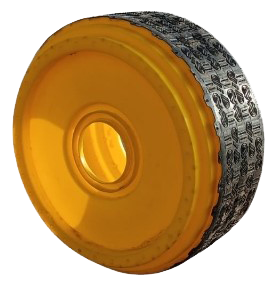
Thanks to this initiative, we received funding to carry out the production design of a modular mat for the MAR.
The assembled mats create a tread whose surface is characterized by reliefs that, on the one hand, improve grip and, on the other hand, identify the product with the text MAR (Multipurpose Amphibious Rover) and the Def-Tech logo.
In fact, the MAR is particularly proposed to operate on complex terrains such as marshy areas, snowy areas, sandy terrains and areas, or generally on mixed terrains (mud) of water and land. When passing over these terrains, tire tracks remain clearly visible even for long periods.
Based on this consideration, the logo and text are sculpted in both positive and negative relief on the tread. In this way, as the vehicle passes, it clearly imprints its name and logo onto the ground.


WineGRover
Project TitleViticulture innovative management by means of IoT and PA solution to reduce environmental impact
The main objective of the project is to decrease the environmental impact associated with grape production by introducing new technologies for precision agriculture (PA) and validating the technical performance of an economical and integral solution based on the implementation of a new PA system in two vineyards in Italy and Spain.
The system consists of the integration of the following components:
- AERIAL DRONE – An aerial remotely piloted component equipped with sensors;
- TERRESTRIAL ROVER – An innovative autonomous terrestrial electric rover that moves along vineyards and is equipped with multi-sensory instrumentation for proximal sensing and actuators;
- GROUND STATION – A ground control station for mission control and real-time localization system;
- SENSORS PLATFORM – A sensor platform for real-time data and ground monitoring of main microclimatic parameters;
- IoT PLATFORM & SOFTWARE – An IoT management platform, Advanced Data Analytics, and processing/visualization software.
The terrestrial Rover used is our proprietary MAR, integrated with a control station also entirely designed by our group and a sensor platform that we partially created together with the University of Tuscia and Wellness TechGroup (Spain).
GO to project website ➔
AgridroneVision
Project TitleIntelligent Integrated System for Innovative and Sustainable Management of Agro-Environmental Ecosystems
The project idea called AgridroneVision focuses on the creation and development of an integrated and intelligent system for innovative, high-tech applications in the precision agriculture sector.
The system consists of an aerial, remotely piloted component equipped with multi-sensory instrumentation dedicated to proximal sensing, a ground control station, and an innovative terrestrial drone, alongside a series of sensors for monitoring key microclimatic parameters.